

The Ambassador of Poland to Kenya, Mirosław Gojdź, has described the 2025 Kenya Trade & Investment Roadshow as an “eye-opening” mission that offered foreign investors a rare and direct look into Kenya’s economic potential.
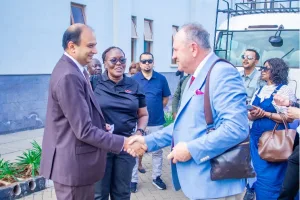
Speaking during a visit to Tononoka Group in Nairobi’s Dandora area, where he led a delegation of Polish business leaders from the manufacturing and real estate sectors, Ambassador Gojdź said the mission was of high impact.
“The mission It provides a great opportunity for investors and businesspeople to discuss establishing partnerships,” he said.
“My presence here, together with representatives from the Polish Trade and Investment Agency, demonstrates how interested we are in exploring opportunities to work together for the benefit of investors from both our countries.”
The Tononoka visit was one of several sector-based tours during the week-long Roadshow, which brought together more than 350 investors from 35 countries. The mission organized by Equity Group saw investors visit Rwanda and Kenyan businesses.
Delegates visited Special Economic Zones, industrial parks, logistics corridors, manufacturing hubs, agribusiness projects, and ICT and innovation ecosystems. The site visits were paired with structured networking sessions that enabled investors to engage directly with policymakers, industry leaders, and potential Kenyan partners.
At Tononoka Group, Joern Mark Siegle, Vice President of Frankfurt Rhine-Main, Germany’s third-largest metropolitan region, praised the steel manufacturer’s operations and long-standing contribution to East Africa’s infrastructure sector.
“I’m very impressed by Equity Bank for creating this opportunity through its trade mission,” he said. “We have been able to establish several personal connections, which are essential before business engagements follow. Seeing the operations at Tononoka Group… has been eye-opening.”
Siegle added that he would brief German firms interested in entering the East African construction market about the company’s capabilities.
The trade mission underscored Kenya’s position as more than a domestic market of 57 million people.
Throughout the panel discussions and site tours, speakers emphasized Kenya’s role as a gateway to a regional consumer base of more than 500 million across Eastern and Central Africa.
Real estate emerged as a priority sector for many visiting investors.
A tour of Tatu City, the 5,000-acre mixed-use Special Economic Zone in Kiambu County, drew significant attention for its planned residential, educational, medical, commercial, and industrial developments.
Delegates were briefed on infrastructure plans designed to support more than 250,000 residents.
Cameroonian investor Jeannette Amom said the mission provided valuable insights.
“The site visit at Tatu City allowed us to assess investment potential across multiple segments of a modern urban development,” she noted.
She added that SEZ incentives, including reduced corporate tax, zero-rated VAT, import duty exemptions, and stamp duty waivers, were key considerations for evaluating investment viability.
Participants said they would undertake further due diligence, focusing on projected returns, competitive positioning, and regulatory conditions.
Many cited the need for credible local partners, policy clarity, and long-term guarantees as essential factors in investment decisions.
AQ Hamza, Director for International Trade Relations at Equity Group, said the tours were structured to help investors interpret Kenya’s opportunities within a clear regulatory and economic context.
“By highlighting Kenya’s regulatory framework, infrastructure, talent pool, and sector-specific advantages, the mission aimed to demonstrate the country’s potential as a gateway for scalable, high-growth investments in the region,” he explained.
In Limuru, investors toured a dairy processing facility where they observed modern yoghurt and fresh milk lines from raised viewing corridors.
Beyond machinery and packaging, delegates were shown the larger ecosystem that feeds the plant, hundreds of small-scale farmers supplying milk daily through cooperatives.
At a collection point, farmers arrived with chilled cans, received instant mobile payments, and consulted extension officers on feed, hygiene, and animal health.
During a briefing, managers outlined cooling systems, antibiotic checks, quality standards, and solar-powered chillers used to reduce losses.
Another stop, ForestFoods, offered a different perspective on agricultural productivity, one rooted in ecology.
Visitors walked through beds of kale, herbs, and legumes growing in mixed systems, observed windbreaks and flowering strips attracting beneficial insects, and saw compost operations that support soil health.
Farm staff openly discussed pests, labour needs, and ongoing experimentation, describing how regenerative practices improve yields over time and reduce dependence on costly inputs.
The 2025 Kenya Trade & Investment Roadshow brought together policymakers, investors, and entrepreneurs in a coordinated effort to interpret Kenya’s economic landscape through field observations rather than presentations alone.
Across steel production floors, modern SEZ corridors, urban development projects, farms, and processing plants, participants were able to examine real operational environments and engage directly with those shaping Kenya’s economic sectors.
Read Also: 30 Plus Free Scholarships For Kenyans To Study In UK Universities