

President William Ruto has defended the controversial Kenya–US Health Cooperation Framework, telling Kenyans that the agreement marks a major step toward strengthening the country’s healthcare system, modernising hospitals, and improving disease preparedness.
Speaking during the signing ceremony in Washington, D.C., the President said the framework ushers in “a transformative and historic partnership” that will build a stronger and more resilient health sector over the coming years.
Ruto emphasised that the United States has been one of Kenya’s most consistent development partners in health, noting that American support has exceeded $7 billion over the last 25 years, funding critical programmes against malaria, HIV, tuberculosis and other major outbreaks.
President Ruto’s message to Kenyans
“For over a quarter of a century, the United States has walked alongside Kenya,” Ruto said. “This partnership has saved millions from malaria, HIV, tuberculosis and other life-threatening outbreaks. Together, we have built resilience, restored hope and supported impactful institutions.”
The framework has generated intense public debate at home, with critics questioning its scope, timing and the level of control foreign agencies may have in Kenya’s health systems. However, Ruto insisted the deal is designed to advance the government’s Universal Health Coverage (UHC) agenda and address long-standing gaps in equipment, financing and emergency readiness.
According to the statement, the collaboration will support the supply of modern medical equipment in public hospitals, improve the delivery of health commodities, strengthen health insurance for all Kenyans, and boost the country’s disease surveillance and emergency preparedness.
“The Framework we sign today adds momentum to my administration’s universal health coverage,” the President said. He highlighted that the partnership will enhance the health workforce, modernise health facilities and ensure efficient, timely delivery of essential supplies.
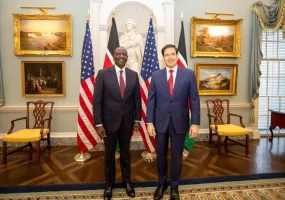
The agreement comes at a time when Kenya is rolling out the new Social Health Insurance Fund (SHIF) and restructuring how health services are financed and delivered. Ruto argued that Kenya must embrace global partnerships to build a system that is “not only stronger and more resilient, but truly sustainable.”
Ruto also announced that the United States—under President Donald Trump’s administration—has committed $1.6 billion in additional support over the next five years to strengthen Kenya’s health sector.
“On behalf of the government and the people of Kenya, I express profound gratitude to the United States and to President Trump for the commitment of $1.6 billion to Kenya,” he said.
The government maintains that the arrangement will not undermine national sovereignty, insisting that the framework is purely cooperative and focused on technical assistance, resource mobilisation and public-health strengthening.
President Ruto further stated: “Under this agreement, the United States will commit 1.6 billion dollars to Kenya over the next five years-resources that will be channelled directly through government institutions, eliminating third-party intermediaries and guaranteeing that support reaches the intended beneficiaries for maximum impact and accountability. This partnership builds upon Kenya’s long-standing health cooperation with the United States, an enduring collaboration spanning more than 25 years and backed by over 7 billion dollars in investment.”
Even as government officials move to reassure the public, the signing has sparked heated debate across social platforms and political circles, with some leaders demanding more transparency on implementation details. Others argue that Kenya urgently needs such international support to address hospital shortages, equipment breakdowns and the rising cost of healthcare.
Ruto, however, said the partnership reflects a “shared resolve” between Nairobi and Washington to modernise healthcare and ensure no Kenyan is left behind.
He urged the country to view the deal not as a threat, but as an opportunity to accelerate development, improve the quality of healthcare workers and build a system capable of responding effectively to future pandemics.
Read Also: 30 Plus Free Scholarships For Kenyans To Study In UK Universities