

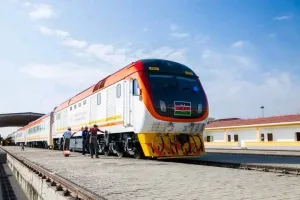
Senior officials from Kenya Railways and the National Land Commission (NLC) on Monday conducted a reconnaissance visit for the proposed Naivasha–Kisumu–Malaba Standard Gauge Railway (SGR) project, signalling that the long-delayed initiative may soon transition from planning to implementation.
The delegation included NLC CEO Kabale Tache, Kenya Railways Managing Director Philip Mainga, NLC Director of Finance and Corporate Planning Bernard Cherutich, and NLC Director of Valuation and Taxation Joel Ombati.
Speaking to The Voice on Tuesday, Tache described the visit as a key preparatory step ahead of land acquisition and project rollout.
“We were identifying public land where the President can conduct the groundbreaking to officially launch the project,” she said, noting that the focus was on publicly owned parcels to ease the initial phase.
The officials held a consultative meeting at Kodiaga Prison, where they reviewed land parcels proposed by Kenya Railways for the groundbreaking ceremony. The team later conducted on-site verification visits at Kibos and Kodiaga Prison, ultimately agreeing that Kodiaga offered the most viable location.
Tache emphasised the need to prioritise public land, anticipate potential challenges early, and ensure structured engagement with local leaders and host communities. She added that the project is expected to be ready by June next year.
The SGR extension will traverse multiple properties and require compensation for affected landowners. Tache reaffirmed NLC’s commitment to ensuring that land acquisition is carried out in a transparent, inclusive, and sustainable manner.
Established under Article 67(1) of the Constitution of Kenya (2010), the NLC derives its mandate from the National Land Commission Act (2012), the Land Act (2012), and the Land Registration Act (2012). Under Section 107 of the Land Act, the commission is responsible for compulsory land acquisition on behalf of both national and county governments, following a formal request from the relevant Cabinet Secretary or County Executive Committee Member.
Last year, Roads and Transport Cabinet Secretary Davis Chirchir announced plans to utilise proceeds from the Railway Development Levy (RDL)—charged on imported goods—to finance the SGR extension.
The government is also engaging development partners to secure additional funding for the 475-kilometre line, comprising Phase 2B (Naivasha–Kisumu) and Phase 2C (Kisumu–Malaba), estimated to cost $5 billion (Sh645.8 billion).
The railway will pass through Narok, Bomet, Nyamira, Kisumu, and Busia counties, with compensation предусмотрed for affected residents. Feasibility studies, environmental impact assessments, and social impact analyses have already been completed.
Kenya has committed to developing the project concurrently with Uganda, while South Sudan is also being integrated into the wider East Africa Rail Corridor.
Speaking at a ministerial meeting in Nairobi attended by his Ugandan and South Sudanese counterparts, Chirchir said Kenya is keen to move quickly, noting that Uganda has already made progress.
“We have a clear programme and are consulting development partners to finalise financial closures. This is not a cheap project,” he said.
The RDL currently raises approximately Sh50 billion annually following the increase of the levy from 1.5 per cent to 2 per cent, which took effect on December 27, 2024. In the 2023/24 financial year, the government collected Sh31.7 billion under the previous rate.
Chirchir ruled out further levy increases, saying the government is instead exploring alternative financing models, including concessioning SGR freight operations and supporting neighbouring countries to establish logistics hubs in Kenya.
As preparatory works gather pace, the Naivasha–Kisumu–Malaba SGR project moves closer to reality, with the potential to significantly enhance regional connectivity, trade, and economic integration across Kenya and the wider East African region.