

Across northern Kenya, resilience is not declared—it is demonstrated.
The past year has brought a series of external shifts that have reshaped the operating environment across development and conservation spaces. Global conflicts, tightening financial flows, and the withdrawal of major funding streams have altered the rhythm and reach of many programmes. In regions where continuity is essential, such changes are immediately felt.
And yet, across the northern Kenya landscape, something has remained steady.
Community meetings continue to take place. Grazing systems are still being coordinated. Wildlife monitoring persists. Local governance structures remain active. These are not isolated activities—they are the everyday mechanics of how communities manage land, livelihoods, and relationships.
Their continuity points to something deeper.
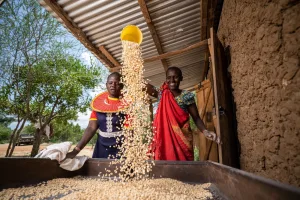
Over more than two decades, the Northern Rangelands Trust (NRT) has worked alongside communities to build systems that extend beyond individual projects. Conservancy governance, councils of elders, trained community scouts, and coordinated rangeland management are not temporary constructs. They are embedded structures—designed to function within the realities of the landscape.
When external support shifts, these systems do not disappear. They adjust in scale, but not in principle.
A conservancy leader in Samburu describes the difference:
“What we have now is a way of working together. Even when things become difficult, we still meet, we still agree, we still plan. That is what keeps things moving.”
This is where long-term presence becomes significant.
In landscapes shaped by climate variability and resource pressure, effectiveness is rarely defined by entry alone. It is defined by continuity—by the ability to remain engaged through cycles of change, to understand local dynamics, and to work within them over time.
According to Moses Wakhisi, Director of Communications:
“The most important investment over the years has been in systems that communities understand and trust. That’s why even when the environment changes, those systems continue to function. They are not dependent on a moment—they are built over time.”
At the same time, the current context is not without its pressures.
Reduced funding has led to a scaling down of certain engagements, particularly in areas that rely on consistent facilitation, such as peace dialogues and outreach platforms. In some locations, this has begun to place additional strain on existing systems.
These shifts are part of a broader global pattern.
As geopolitical priorities evolve, resources are being redirected, and development spaces are becoming more fluid. In this environment, new actors may enter, bringing different approaches and perspectives.
But in northern Kenya, experience remains a defining factor.
Understanding the interplay between land, livestock, community dynamics, and governance is not immediate. It is developed through years of engagement—through drought cycles, conflict resolution, and incremental system-building.
An elder from Laikipia reflects on this:
“This land teaches slowly. You cannot understand it in a short time. You have to stay, to listen, to see how things change. That is how you learn what works.”
This accumulated understanding shapes how interventions are designed and delivered.
It influences how communities engage, how decisions are made, and how systems are sustained. It also explains why, even in a shifting environment, much of the work across the landscape continues to hold.
And the experience of 2025 has sharpened that reality.
It has tested assumptions, exposed where systems are most vulnerable, and clarified what holds under pressure. In doing so, it has refined how NRT operates—more focused, more adaptive, and even more grounded in the lived realities of the communities it serves.
The result is not just continuity—but evolution.
Looking ahead, the pressures facing northern Kenya are unlikely to ease. Climate variability remains a constant. Resource competition continues. And the systems that support stability—governance, coordination, and dialogue—will need to keep evolving.
What is already evident, however, is that where these systems are well established, they continue to function—quietly, consistently, and with a level of resilience that is not easily replicated.
In northern Kenya, that continuity is not static.
It is being strengthened.