

A generation grappling with economic instability, political disillusionment, and mounting mental health pressures is demanding a radical rethinking of leadership and governance in Kenya.
This was the prevailing message at a youth convening held in Westlands under the theme “Whose Future Is It Anyway?” The forum, facilitated by Nigerian leadership development organisation LEAP Africa, brought together young policy analysts, IT experts, and community leaders determined to confront what they described as systemic failures locking youth out of meaningful participation.
Economic Uncertainty and the “Gig” Question
At the heart of the discussion was the quality — not just the quantity — of opportunities available to young people. Participants challenged the framing of the gig economy as a sustainable employment solution, arguing that it often masks deeper structural weaknesses.
Annmercy, an IT governance expert, cited sobering data indicating that nearly 70 percent of businesses started in sub-Saharan Africa fail before reaching the five-year mark.
“We are talking about the gig economy, but what is this kind of structured job where you have work today and in two weeks you’re jobless?” she posed, questioning whether short-term contracts and digital piecework can genuinely anchor economic stability.
She urged policymakers and institutions to co-create durable systems with young people — models capable of generating enterprises that not only sustain founders but create employment for others.
Civic Space and Political Disengagement
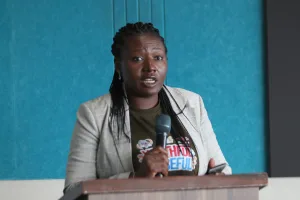
The forum also examined civic participation trends across East Africa. Youth leader Benson Gachoki drew parallels between regional political climates, pointing to media suppression and restrictions on dissent in some neighbouring countries, while warning of growing voter apathy among Kenyan youth as the country approaches another election cycle.
“In Kenya, we are struggling with young people who are not involved in elections,” he said, describing apathy not as indifference but as frustration with systems perceived as unresponsive to youth concerns.
Participants argued that disengagement is often rooted in exclusion from policy formulation and decision-making processes, rather than a lack of interest in governance.
Mental Health: The Silent Barrier to Leadership
Beyond economics and politics, the conversation turned to mental wellness as a prerequisite for sustainable leadership.
Diana Ammabele, Director of Programs at LEAP Africa, underscored what she termed a “silent crisis,” linking anxiety, depression, and burnout to global instability, economic pressure, and social media influence.
“You cannot optimize young people as leaders without addressing their health and well-being,” Ammabele said, calling for structured mental health programming to accompany leadership development initiatives.
Participants agreed that mental resilience is foundational to innovation and civic engagement, warning that untreated stress and uncertainty could erode the very leadership potential institutions seek to harness.
From Tokenism to “Responsible Expansion”

The forum rejected models that position young people as passive beneficiaries of policy or donor-driven interventions. Instead, attendees proposed a framework of “Responsible Expansion,” advocating for data-driven, culturally nuanced, and genuinely youth-led initiatives.
As LEAP Africa formally begins operations in Kenya as part of its broader East African engagement strategy, youth at the forum delivered a clear message: partnerships must be rooted in listening rather than patronage.
“The solutions already exist within our communities,” one participant noted. “The question is whether institutions are willing to invest in them sustainably.”
The convening concluded with a unified call for structural reform — one that moves beyond hustle culture to build resilient systems capable of delivering dignified, long-term opportunities for Kenya’s youth.